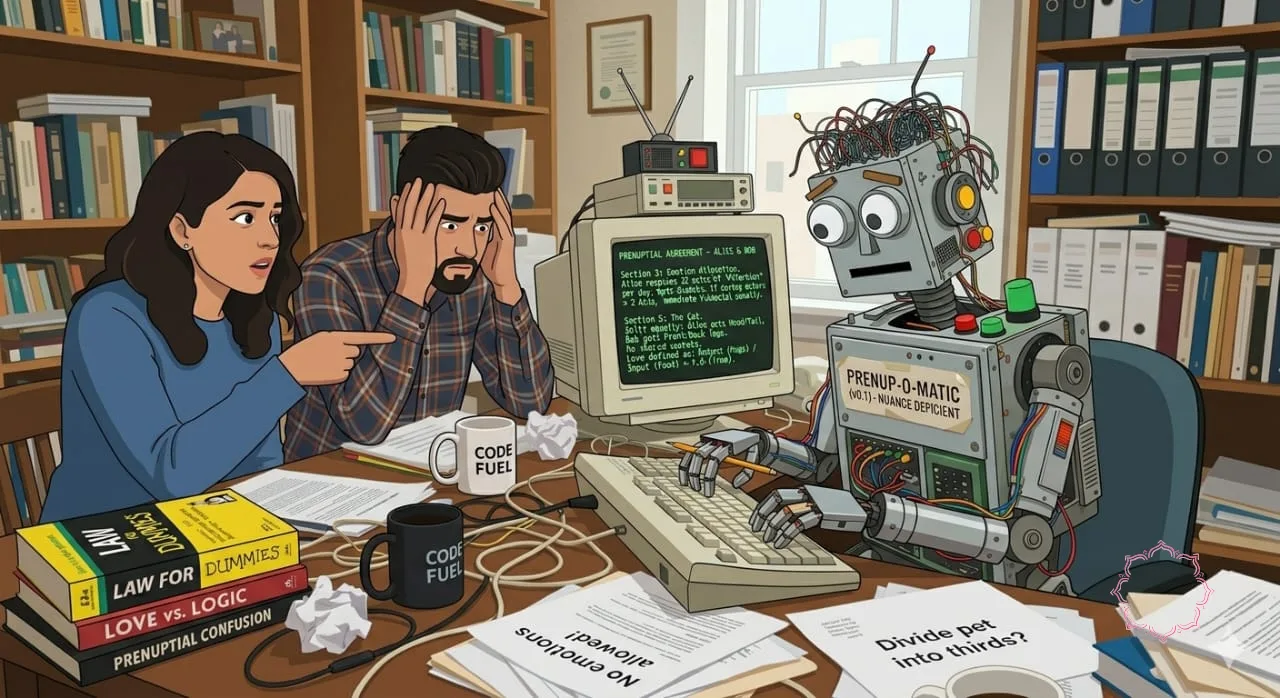
Artificial intelligence tools like ChatGPT, Gemini, Claude, Perplexity, and Meta AI have transformed the way people access information and draft documents. They have made it easier than ever to generate legal-looking documents within minutes. With just a simple prompt, AI tools can generate contracts that appear polished and legally structured. Naturally, many couples now wonder: Can I create a prenuptial agreement using AI?
Technically, the answer is yes. Practically and legally, however, the answer is far more complicated. The more important question is whether you should. This article explains how AI-generated prenups work, their risks, and why relying on them, especially in India, can lead to serious legal consequences.
Can AI Help You Create a Prenup?
AI tools can generate a basic prenuptial agreement within seconds. A user can input details about assets, liabilities, or preferences regarding financial arrangements, and the system will produce a document that resembles a formal contract. At first glance, this seems efficient, cost-effective, and convenient. However, this convenience often creates a false sense of security.
AI tools can generate a prenup by:
– Asking you questions about assets, debts, and preferences
– Producing a draft based on general legal templates
– Customizing clauses such as asset division, maintenance, or financial responsibilities
For example, you might prompt an AI tool:
“Draft a prenuptial agreement under Indian law where both parties waive alimony and retain separate property.”
Within seconds, you will receive a structured document that appears professional and comprehensive.
However, this convenience can be misleading.
Why AI-Generated Prenups Are Risky
Despite their speed and accessibility, AI tools are not a substitute for qualified legal advice — especially for something as sensitive and complex as a prenuptial agreement.
1. Legal Validity of Prenups in India
Prenuptial agreements are recognised differently under Indian law that requires nuanced legal understanding, not in the same way as in countries like the US. Courts may consider them, but enforceability depends heavily on fairness, intent, and compliance with public policy. AI-generated prenups typically rely on generalized templates, many of which are influenced by foreign legal systems. As a result, they may include provisions that are either irrelevant or unenforceable in the Indian context.
AI tools:
– Do not account for evolving Indian case law
– Cannot ensure enforceability in a specific jurisdiction
– Often generate agreements based on foreign legal systems
For NRI couples or couples with cross-border assets, learn more about how to draft a prenup in our Comprehensive Guide On Prenups For NRIs.
2. No Understanding of Personal Context
Another significant limitation of AI is its inability to understand personal and cultural nuances. A well-drafted prenup in India must account for factors such as joint family structures, intergenerational assets, succession & inheritance laws, religious personal laws, Dowry Prohibition Act provisions, Domestic Violence (DV) Act provisions, social expectations, and evolving financial roles within a marriage.
These are not merely legal considerations but deeply contextual ones. AI cannot engage in meaningful dialogue, ask probing follow-up questions, or identify subtle imbalances between parties. It produces output based only on the information it is given, without the judgment required to assess fairness or long-term implications.
A valid prenup must reflect:
– Family structure and expectations
– Cultural considerations (joint families, parental assets)
– Succession & inheritance plans
– Estate plans
– Financial realities and future plans
AI lacks the ability to:
– Ask nuanced follow-up questions
– Identify red flags (coercion, imbalance, unfair clauses)
– Tailor clauses to Indian socio-legal contexts
3. Risk of Unfair or One-Sided Clauses
There is also a real risk that AI-generated agreements may contain clauses that are overly simplistic, one-sided, or legally weak. For example, blanket waivers of maintenance or alimony may not be upheld if they are deemed unconscionable or if they fail to consider future contingencies. Similarly, inadequate financial disclosure or the absence of independent legal advice can undermine the credibility of the agreement. Courts are particularly cautious when evaluating such documents, and any indication of unfairness can render them unenforceable and ineffective.
Courts are more likely to reject agreements that are:
– Grossly unfair
– Signed without adequate disclosure
– Executed without independent legal advice
AI-generated drafts often:
– Over-simplify asset division
– Include blanket waivers (e.g., no maintenance) that may not hold up
– Miss mandatory disclosures
4. No Confidentiality or Legal Privilege
Confidentiality presents another significant concern. When individuals input sensitive financial and personal information into AI platforms, they do so without the protection of attorney-client privilege. This raises legitimate questions about data handling and privacy, especially when dealing with high-value assets or complex financial arrangements.
When you input sensitive financial or personal data into AI platforms:
– There is no attorney-client privilege
– Data may be stored or processed externally
– You risk exposing confidential information
5. No Accountability
Perhaps most importantly, AI lacks accountability. A qualified legal professional ensures the accuracy and legality of the document. They guide clients through the drafting process, ensure compliance with applicable laws, and help execute the agreement correctly. In contrast, AI tools provide no such assurances. If the agreement fails or is challenged in court, the AI will have misguided the couple without them even realising it until it is too late.
If a lawyer drafts your prenup:
– They help ensure accuracy and legality
– They guide you through proper execution and compliance
If AI generates it:
– There is no responsibility if the agreement fails in court
– You bear all legal risks
How to Use AI Safely in the Prenup Process
This does not mean that AI has no role to play. It can be a useful starting point for understanding what a prenuptial agreement typically includes, or for organizing thoughts before seeking professional advice. However, it should never replace a lawyer in the actual drafting and review process.
AI can still be useful — but only as a supporting tool. You can use AI to:
– Understand what is typically included in a prenup
– Generate a rough checklist of clauses
– Prepare questions before consulting a lawyer
However, the final agreement should always be:
– Drafted or reviewed by a qualified legal professional
– Tailored to Indian law and your personal circumstances
– Properly executed with adequate disclosure and consent
To learn more about the prenup drafting process, read our guide on How To Get A Prenup In India.
Why Choose a Legal Expert Like Prenup India
Modern couples are informed, independent, and often digitally savvy. At Prenup India, we bridge the gap between modern needs and legal realities.
We understand that every relationship — and every financial situation — is unique. At the same time, we understand the legal and cultural complexities that prenuptial agreements must address in India.
Our approach is to provide carefully tailored agreements that reflect each client’s unique circumstances while aligning with Indian legal principles. We ensure that every document is balanced, thoughtful, and capable of withstanding scrutiny.
Our approach ensures:
✅ Legally sound agreements aligned with Indian law
✅ Culturally sensitive drafting for Indian families
✅ Balanced clauses that stand scrutiny in court
✅ Complete confidentiality and professional guidance
Unlike AI tools, we do not rely on generic templates. Every prenup is crafted with precision, care, and legal expertise.
👉 Explore Prenup Packages
👉 Talk to a Lawyer
Artificial Intelligence Is No Match For Real Expertise
AI can generate text or a draft document, but it cannot create a legally reliable prenup. For something as important as a prenuptial agreement, precision, context, and professional judgment are essential.
Relying solely on automated tools may save time in the short term, but it can create significant legal and financial risks in the future. When it comes to protecting your finances and relationship clarity, and securing your future together, cutting corners with AI tools can cost far more in the long run.
If you are considering a prenup, use AI for awareness — but trust a legal expert for execution.